


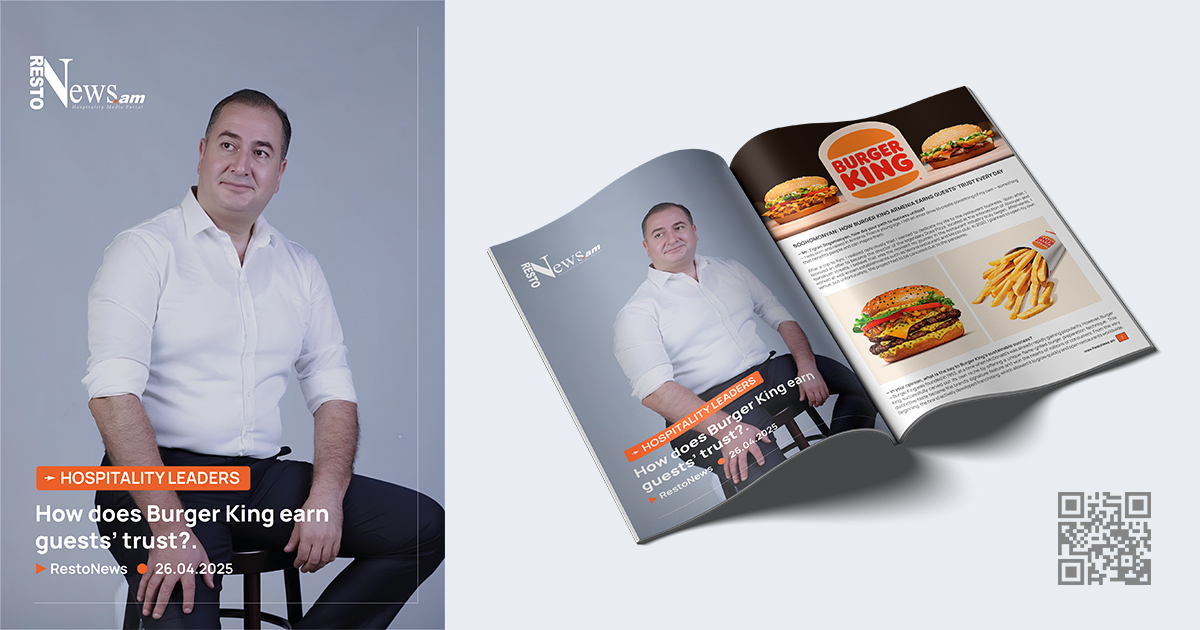
Soghomonyan: How Burger King Armenia earns guests’ trust every day
“With a brand like this, you cannot afford to operate at an average level — only at a high level,” noted Tigran Sogomonyan, CEO of Burger King Armenia, in an exclusive interview with HoReCa Magazine Armenia.
— Mr. Tigran Sogomonyan, how did your path to success unfold?
— I was born and raised in Armenia. From a young age, I felt an inner drive to create something of my own — something that benefits people and can inspire them.
After a trip to Kyiv, I realized definitively that I wanted to dedicate my life to the restaurant business. Soon after, I received an offer to become the director of the legendary Doka Pizza, located at the intersection of Abovyan and Isahakyan streets. I believe that was the moment my journey in the restaurant industry truly began.Soghomonyan

Afterwards, I worked at well-known establishments such as Verona restaurant and Mezzo club. In 2020, I planned to open my own venue, but unfortunately, the project had to be canceled due to the pandemic.
Later, I joined EL Holding, and then worked at Santafe and Pahest 33. At Monogram restaurant, I held one of the executive positions. And just recently, I was invited to take on the role of General Director of the Burger King network in Armenia. My path in the restaurant business has been intense and challenging, but it is precisely this experience that shaped me into who I am today.
— In your opinion, what is the key to Burger King’s sustainable success?
— Burger King was founded in 1953, at a time when McDonald’s was already rapidly gaining popularity. However, Burger King successfully carved out its own niche by offering a unique flame-grilled burger preparation technique. This distinctive taste became the brand’s signature feature and won the hearts of millions of consumers. From the very beginning, the brand actively developed franchising, which allowed it to grow quickly and open restaurants worldwide. Soghomonyan
In Armenia, we chose a sub-franchise from Russia, as Burger King in Russia consistently demonstrates high quality and strong consumer interest. In addition, Armenia and Russia are part of the Customs Union, which simplifies logistics and creates favorable conditions for business development.
— What features of Burger King have you adapted for the Armenian market?
— We operate as a sub-franchise and strictly adhere to the brand’s international standards. This limits our ability to make changes to the menu or operational processes.
Nevertheless, we strive to adapt the service and atmosphere of the restaurant to local preferences—whether it is staff courtesy, speed of service, or particular attention to customer feedback. Our goal is to maintain the brand’s signature quality while simultaneously being closer to the Armenian consumer.

— What are the main challenges you face in managing a restaurant chain in Armenia?
— One of the main challenges is recruiting and training staff. In the fast-food segment, we primarily work with young employees, and although training takes only about a week, staff turnover remains high.
We are constantly working on team motivation, creating opportunities for professional growth, and striving to retain skilled employees, which is especially important for the stable operation of the chain.
— How do you handle situations when a guest is dissatisfied? Is there a response system in place?
— We pay close attention to every review. The main part of our business is delivery, and it is in this segment that challenges arise—whether due to delays or human error.
We have an internal complaint management system: we contact clients, identify the reasons for their dissatisfaction, and respond promptly. All information is analyzed, and decisions are made based on it to improve the service. We believe that even negative feedback helps us become better. — Soghomonyan

— Mr. Tigran Soghomonyan, how do you assess the development of restaurant culture in Armenia and your role in this process?
— I am sincerely glad that Aram Mnatsakanov and the Lucky Group team have opened a restaurant in Armenia. This event demonstrates that leading culinary players are increasingly placing their trust in our market.
Moscow today is one of the global leaders in the restaurant industry, and the emergence of such projects in Yerevan is both inspiring and raises the bar for all of us. This creates an incentive for the qualitative growth and development of restaurant service culture in the country. Soghomonyan
— In your opinion, what is the key to Burger King’s sustainable success?
— I am inspired by the very opportunity to do what I love. When work is a pleasure rather than just an obligation, it generates the energy to move forward.
In life, my main source of strength remains my family, friends, and colleagues. Together, we share goals, support each other, and celebrate our collective successes. Soghomonyan

— Mr. Tigran Soghomonyan, how do you keep going without giving up, and what advice would you give to future restaurateurs?
— Svetlana, my advice is simple: clearly define what you want to achieve and assemble a team with whom you can make it happen.
The restaurant business requires effort, dedication, and flexibility. Competition is growing, and without a strong concept, the right pricing strategy, and high quality, success is impossible. Be prepared for challenges, but if you truly love this field—take action and never stop.Soghomonyan