


In this article:
Dinner for two at a Yerevan restaurant has doubled in price over the past year. Restaurateur Ashot Barsegyan told JAM News that not long ago such an evening cost 20,000 drams — about $52. Since January 2025, he estimates, the tax burden on dining has risen 2.5 times. Even so, Armenia’s restaurant market has not slowed down: international chains are moving in, food festivals fill whole streets, and the statistics show growth faster than the country’s economy as a whole.
The sector outpaces GDP
The numbers confirm the feeling. According to the Statistical Committee of Armenia, the country’s GDP grew 5.9% in 2024, while the “accommodation and food service” segment rose 8.7%. Restaurants and hotels, in other words, grew almost half again as fast as the rest of the economy. In short, the restaurant market sets the pace for the wider service sector.
The momentum held all year. In the first half of 2024, dining and accommodation brought in 158.7 billion drams — 10.2% of the country’s total services, on 8.2% growth. Quarter by quarter the picture is the same: in the second quarter of 2024, accommodation and food service added 9.8%, one of the fastest rates of any industry. The head of the State Revenue Committee, Rustam Badasyan, offered another figure: hotel and restaurant turnover grew by 75 billion drams over the year — about $185 million. Most of that gain, he said, came from foreigners and tourists, though the segment’s share of GDP is still modest, around 1.9%.
The impulse carried into 2025. On preliminary figures from the Statistical Committee, Armenia’s GDP grew 6.2% in the third quarter of 2025 against the same period a year earlier — the economy keeps expanding, and with it the appetite for eating out. The World Bank had penciled in growth of about 5% for 2024-2025, so dining is running comfortably ahead of the market.
Who fills the tables
Behind the demand is the flow of tourists. In 2024, 2.2 million people visited Armenia: 4.6% below the record year of 2023 (2.3 million), but still one of the best results on record. The biggest market is Russia, with 937,823 visits — 43% of all guests. Next come Georgia (279,368, 13%) and Iran (178,785, 8.4%). The flow is seasonal, peaking in late spring, summer and early autumn, when the terraces downtown stay busy until midnight.
The geography of arrivals works in the capital’s favor. Nearly 60% of guests arrive through Yerevan’s Zvartnots airport, and another 20% or so through the Bagratashen land crossing on the Georgian border. The main spending tourist, in other words, settles first in Yerevan, where demand is concentrated. For restaurants that means a steady stream of paying guests — especially downtown, home to restaurants for tourists, wine bars and takeaway coffee shops alike.
In 2025 the trend turned up again. According to the Statistical Committee, 1,734,247 tourists visited the country from January to September — 0.8% more than a year earlier. The authorities have set an ambitious target: 3 million guests a year within five years, with a focus on the UAE and the Gulf states and dozens of new direct flights. Every new route is a potential full house on the weekend, and another data point for a growing restaurant market.
The shape of the flow also plays into restaurants’ hands. According to the Statistical Committee, in the nine months of 2025 men outnumbered women among guests — 957,000 against 777,000 — and the largest age group was people aged 36 to 63. That is an audience with money and a habit of dining out, not students with backpacks. For the average check, such demographics matter more than absolute arrival records. This kind of visitor keeps the restaurant market resilient to seasonal dips.
The 2025 tax turning point
The year’s main challenge is tax. On January 1, 2025, Armenia doubled the turnover tax rate for trade, from 5% to 10%. Food service has its own regime — with deductions for documented expenses, the effective rate does not fall below 3.5% of the base, and the accounting rules have tightened. The reform hit Yerevan dining first; in the regions the old order stands until January 1, 2026.
Business took the change hard — hence Barsegyan’s “2.5 times” estimate. CivilNet described the reform as a first step toward gradually phasing out the turnover tax in favor of the general VAT system. From July 2025, certain professional services were moved off the simplified regime and onto VAT altogether — a signal that the state is methodically closing the tax shortcuts. For the restaurant market, that reform rewards operators who keep clean books.
There is another side to it. The smallest players keep a break: micro-businesses in hospitality with annual turnover up to 24 million drams can operate at a zero rate. A family café or a guesthouse in the regions still pays almost no turnover tax. For small venues in Yerevan the change means higher costs and more paperwork; for the market as a whole, it is an incentive to consolidate and go legit. As a result, the restaurant market grows more transparent, even at the cost of weaker outlets closing.
Two festivals in one summer
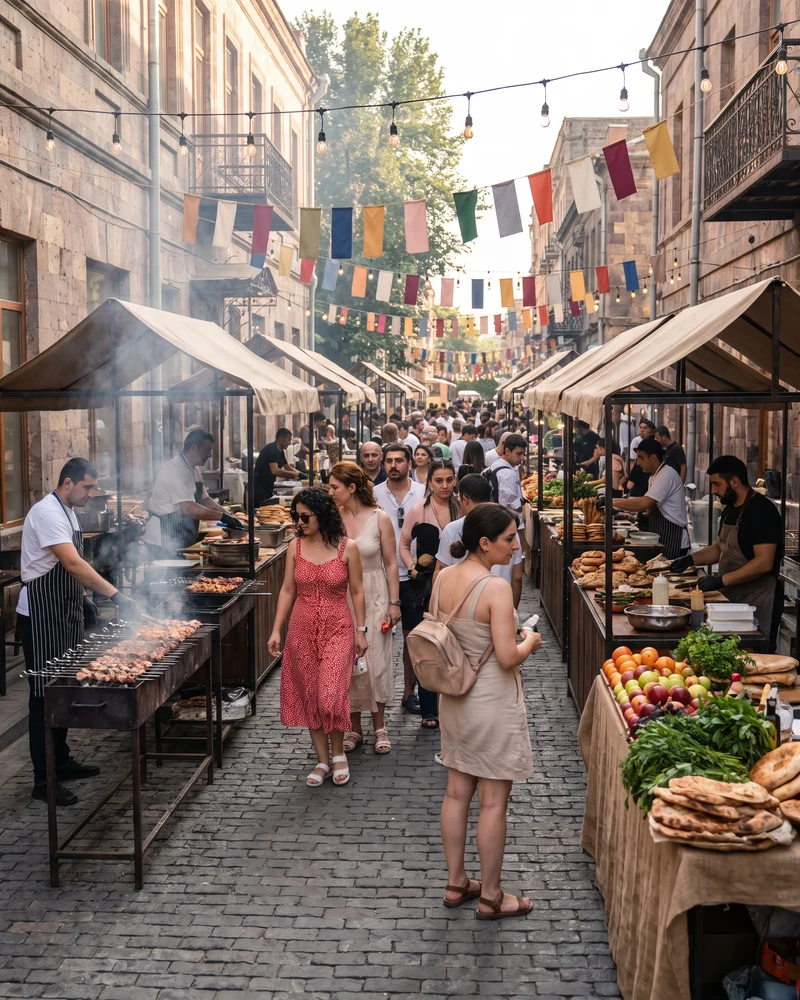
Tax pressure notwithstanding, the city lives on food. The Yerevan Gastro Show ran June 7-9, 2024, at the junction of Moskovyan, Saryan and Baghramyan. Among the participants was Davy Tissot, a two-Michelin-star chef and Bocuse d’Or winner; alongside him worked the teams from Armenia’s best restaurants.
A month and a half later came RestoFest (July 19-21): Tumanyan and Moskovyan streets, more than 100 restaurant concepts, master classes right on the pavement. For three days straight, central Yerevan ran on food. Venues like these are not just a party but a showcase: new projects test the crowd, and guests find addresses they will come back to.
The flagships hold the bar
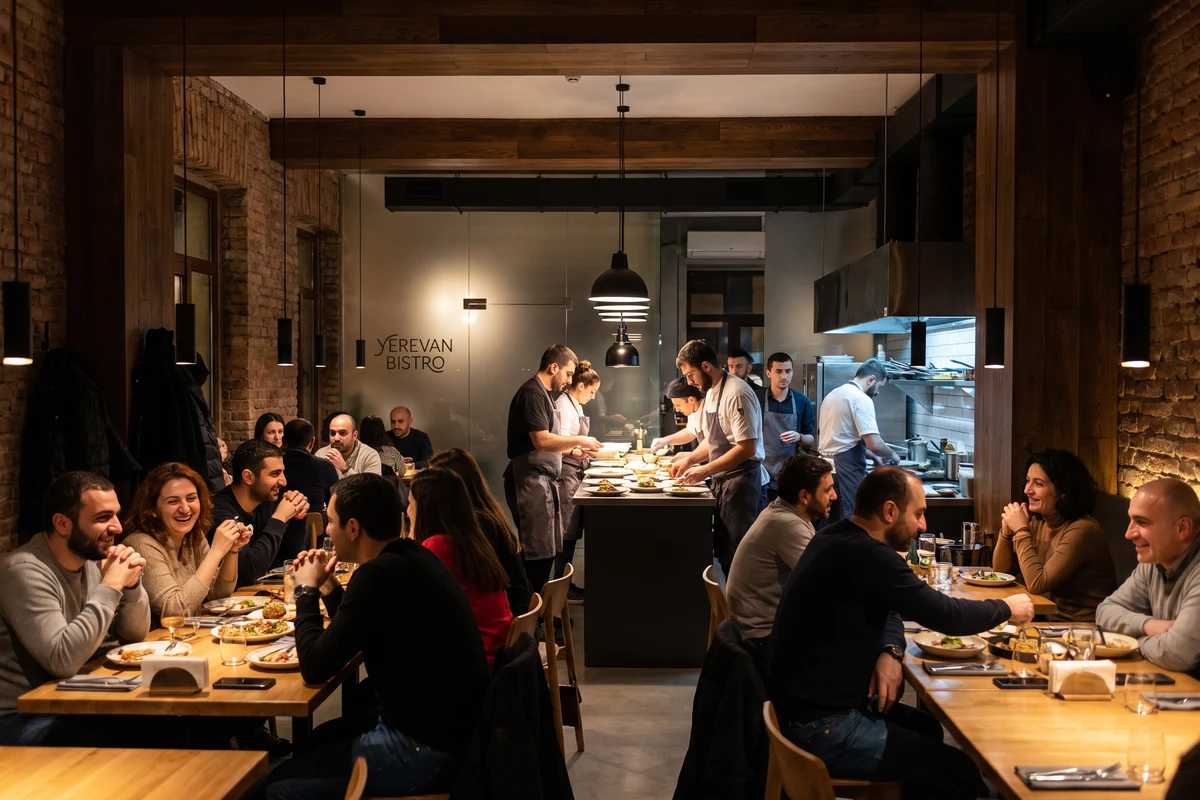
The local backbone of the market is the big groups. Yeremyan Projects built its own farming arm: it buys produce straight from farmers. Its two flagships, both opened in 2017, still set the standard:
- Sherep — 1 Amiryan, by Republic Square (opened November 10, 2017). An open kitchen: the guest watches the dish being cooked.
- Lavash — 21 Tumanyan (opened April 2, 2017). Direct farm-to-table supplies and lavash from the tonir baked right on the ground floor.

Around these anchors an independent scene is growing too — from wine projects where Armenian wines are pushing out imports, to intimate coffee shops and places that live on morning traffic: Yerevan’s best breakfasts have long become a genre of their own. This independent layer widens the restaurant market rather than only pushing it upmarket.
International chains move in for real
Global brands see the same trend. Burger King came to Armenia back in 2017, opening its first restaurant in Dalma Garden Mall. In 2025 another fast-food giant took up the baton: Wendy’s signed an exclusive franchise agreement with Wen Restaurant LLC (part of Connect Group) for 20 restaurants in Armenia by 2030.
The first location is promised for central Yerevan. “Launching Wendy’s in Armenia is a bold step in reimagining quick service in our country,” said Wen Restaurant CEO Hrant Grigoryan. For the chain itself, it is part of a global expansion: the agreement was announced in one package with Italy — up to 190 new restaurants across the two countries combined, with Wendy’s planning roughly 70% of its growth outside the United States.
The arrival of global brands is not only competition but a vote of confidence: international operators enter Armenia’s restaurant market where they see growing, solvent demand and predictable rules. For local players it is a challenge to hold their service standard and, at the same time, a chance to learn from others’ benchmarks.
What lies ahead for Armenia’s restaurant market
The picture cuts both ways. On one side, a rising tax and higher prices that squeeze the margins of small venues. On the other, a steady flow of tourists, a segment growing faster than GDP, and global chains ready to invest for the long haul. Armenia’s restaurant market is entering a phase where the survivor is not the cheapest player but the most systematic one: with transparent accounting, its own logistics and a guest it understands.
The tax reform is accelerating the shift to the books — small venues with a gray till lose to those that can document their costs and run on volume. For the guest, it most likely means a slightly higher check, but steadier service too. That trade-off is what a maturing restaurant market tends to deliver.
The food festivals show the demand, the statistics show the money, and deals on the scale of Wendy’s show investors’ faith that the tables in Yerevan will only get busier. The next two years will show who survives the tax turning point and turns the tourist flow into steady revenue. Either way, the restaurant market looks set to stay one of the country’s liveliest sectors.
Key takeaways
- Growth faster than the economy. Dining and accommodation rose 8.7% in 2024 against 5.9% GDP growth; the segment’s turnover grew by about $185 million.
- Tourism sustains demand. 2.2 million guests in 2024, up 0.8% over the nine months of 2025; the authorities’ target is 3 million a year.
- The tax doubled. The turnover tax rate for trade rose from 5% to 10%; Yerevan dining from 2025, the regions from 2026. Hospitality micro-businesses up to 24 million drams stay at a zero rate.
- Global chains are moving in. Wendy’s is opening 20 restaurants by 2030, following Burger King. For investors, the restaurant market now reads as a bet on rising demand, not an experiment.